-
In this video, I want to share with you a sneak preview of what you can expect in the book study that I will be facilitating starting January 5th and extend a personal invitation for you to join us for a five-week book study that I have designed specifically with the intention to support you in setting and achieving unreasonable goals. Now, I know the new year is almost here, 2027, if you can believe it. And of course, a lot of people are going to make New Year's resolutions and we know from experience and we've seen the data and perhaps by our own experience that by January 14th, most of those are obsolete. This book study is a labor of love, is something that I am really looking forward to. And my intention is to offer an alternative or at least something you can do alongside those resolutions that will really help you keep those resolutions and really create something extraordinary. It's about shifting your mindset. It's about a collection of five one-point lessons that I've picked from the book that collectively will enable you and empower you to truly be in control of the outcomes that you create. But let me tell you about the book itself before I give you a sneak preview of each of those five specific chapters that I've picked that we're going to cover in this book study.
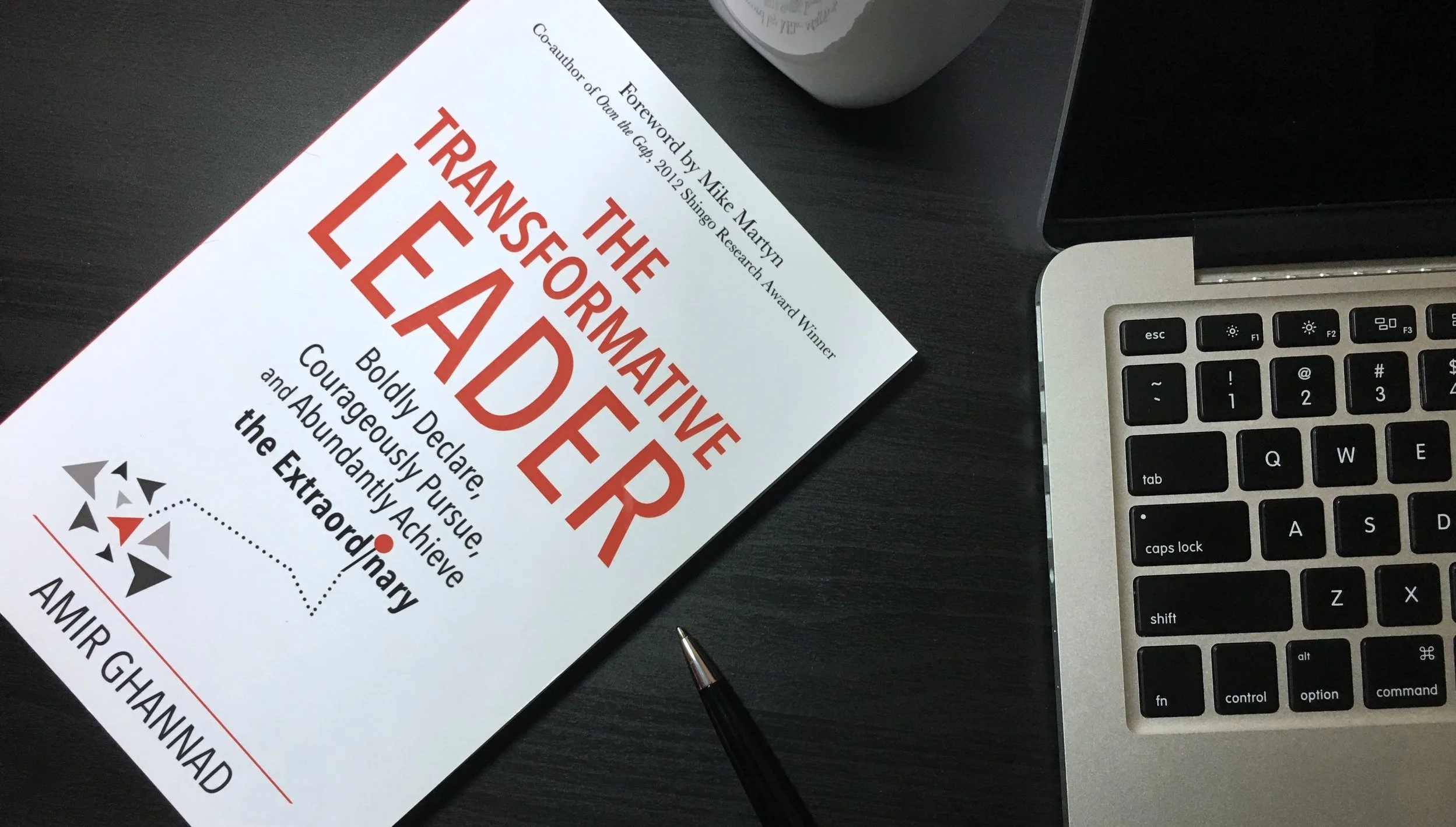
Honestly, the title of the book is somewhat of a misnomer now that I look back on it. You know, The Transformative Leader. Sometimes people might think that this book is for those who are in a leadership position that you have to have some kind of a formal leadership role to benefit from this book. And that is not true at all. There are some parts of this book that speak very specifically to what leaders need to do to create the right culture and so on and so forth. Yes, that is true. But the last two-thirds of this book is a combination of 20 one point lessons and each of them are about three or four pages long. It's an easy read and these are life lessons that happen to also apply in the workplace. So the subtitle of the book is much more appropriate. I think it's a more appropriate representation of what this book is all about. And the subtitle says boldly declare, courageously pursue and abundantly achieve the extraordinary. And you can certainly apply the principles and the lessons in this book just as much to your personal life as you can to your professional life. In fact, some of my favorite testimonials that I've received have been along the lines of the impact that the teaching in this book or in my workshops really have made in people's personal lives, in their relationships with their loved ones, or in their civic activities and in their communities.
And so that's why I am holding this book study to get in touch with the kindred spirits who are interested in this language that we are introducing in this book and the distinctions that we go over. It's not necessary that you have already read the book. If you haven't read the book, this will be an introduction for you to several distinctions that I think you'll find very interesting. But if you have read the book, that shouldn't be a deterrent for you to participate. I have literally had people who have been to my workshops multiple times. I had this one plant manager one time who brought me in to have this workshop that covers a good bit of what's in the book for his people. This was a four hour workshop and we did this seven times and this plant manager sat in literally on all of these sessions and he was taking notes even in the last session that he was in. And I'm not saying this to say I have so much wisdom. I'm saying this to reinforce that no matter how many times you've read a book or been exposed to some kind of teaching, when the student is ready, the teacher will appear. There are certain things that I still get out of this book when I read it that didn't really jump out at me when I wrote it. And in fact, many times I joke about this and I say that I wrote this book for myself. And, you know, I say this jokingly, but it's a very serious thing because the lessons in this book are just as much of a reminder to me as they are a lesson for somebody else. So I hope you will join us. You can find the link below and learn a bit more about it by going to the webpage that it takes you to and register to participate in this complimentary conversation. But as I promised, I want to go over just a preview of the five chapters that I have picked for us to go over.
The first chapter we're going to go over is titled, Don't Settle for Managing Change, Take on Leading a Transformation. Here again, this lesson is just as applicable in your personal life as it is in your professional life. And what it speaks to is that we have so many things in our personal professional life that could use improvement. And yes, it's really important to be in a continuous improvement mindset and take care of things as they show up in front of us, fix this, repair that, make that a little bit better.
But it's important to make sure that we do all of that in the context of a transformation that we want to cause. If you're only dealing with the problems in front of you, you're going to end up playing whack-a-mole with those. And every time you apply a solution, there is some kind of a side effect and you might find yourself really busy, whether it's at work or at home, just fixing things, making things a little bit better. And then 10 years from now, you're going to find yourself basically in a reality that is just a little bit better version of today's reality.
And so in this chapter, I introduce this distinction between change and transformation, where change really focuses on what has been and what is and tries to improve things a little bit. And transformation really starts with a vision of the future. What sort of discontinuous future do I want to create? Whether it's in my health or my finances or my relationships or my professional life. And then looking back from there, we identify some of the key milestones that we have to reach, some of the key achievements we must have, and those are the ones that we are going to have to protect as we deal with whatever comes our way. When we have a clear vision of where we're going in the future, not only does it make it real clear what are some of those crystal balls, if you will, that we're juggling that cannot hit the ground, but it also sheds light on our everyday priorities, those little things that come up and whether they're really important and we need to deal with them or that they're not really significant in light of where we're going, right? So this distinction between change and transformation is a very important topic that we talk about as the sort of the basis for transformative leadership.
So whether it's in an organization or in your personal life, it is great to step back and declare a transformative future that will provide context for whatever you've got going on. We're also going to talk about why we actually don't do that. Because what I just explained to you is not really rocket science. I mean, at some level, we all understand that that's a good thing to do. But why is it that we understand it, but we don't do it? There are some things that are getting in the way of that and we're gonna talk about it. Now, the challenge that I had in writing this book was that I didn't want to come up with a set of instructions for the reader because I honestly didn't know who was gonna pick this book up and read it. So who am I to say, you should go do this and you should go do that. But the way I solved that problem, just in my own mind, so I could get going with actually writing the book, was that I'm not actually giving you a prescription. I am simply introducing a certain set of distinctions. And then at the end of each chapter, I ask you certain questions about your situation, about how that lesson or those principles apply to your situation. And if you answer those questions, you will gain clarity on your situation. Then I make some suggestions on actions that you should consider. And based on the answers that you've given, you will be clear on what you need to go do next in order to bring that set of principles to life in your own situation.
The next chapter that we're going to talk about is a chapter titled, Do You Meet 100% of Your Commitments? This is a chapter that sheds light on the distinction between 100% commitment and 50-50 commitment. You see, most of our commitments are partial and conditional. We say we are 100% committed to certain behaviors or outcomes. But then, if we really fall short, then we have all kinds of reasons and excuses, right? in that, yeah, you know, I was 100% committed, but this happened and that happened. And yes, many times things get in the way and you could be 100% committed and still not achieve the goals. However, it is important for you to recognize that some of the shortcomings are because you believe that you're 100% committed, but you really are not. And so, In this lesson, I break down the distinction between 100% commitment and 50-50 commitment and how you can identify your 50-50 commitments and how you can empower yourself by actually either declaring that you are no longer committed to that particular cause or elevating your commitment to 100%. And that way, you can be a person that can be counted on and you can be truly committed to creating that transformation that you have declared. I believe you will find the conversation about this chapter very eye-opening because when I present this topic in my workshops, people have a kind of an epiphany about the fact that they have truly not been 100% committed to those things where they thought they were 100% committed. It is always easy to see other people's lack of commitment. But when you see your own and you're able to address it, that makes all the difference for you.
The next chapter that I have picked to include in this book study is titled, If You Can't Run, Walk. In this chapter, I address the fact that most of us are waiting for some sort of a perfect start to get started, right? I wish I had this kind of money or that kind of a boss or this kind of a partner. And if I did, I would be able to do this. And the reality of the situation is that no matter where you want to go, no matter what that transformative vision is, the only starting point you have is right where you are now. And if something is holding you back from making more progress or going faster, You have a couple of options. One is you just stop until the conditions are right and most likely that someday will not be here anytime soon. Or you could just do what you can. A lot of times we don't get into action because we feel like we're not going to make as much progress anyway. And I tell a story about one of my personal experiences in this chapter, and I'll share that with you in the book study. And I'm a hundred percent sure that you will see some parallels for yourself where you've just kind of been waiting for the right conditions. You say, well, you know, I would do this if I could have X, or if I could be this or, whatever else you're waiting for as a starting point. And the point is, you only have one starting point and that is exactly where you are right now. Again, in this chapter, we're going to go beyond just pointing out what should be and well, why don't you go just go do that. We're going to peel this onion a few layers back and show you why it is that you're actually not doing the thing that you know you need to do. So that's what this is all about. None of this stuff that is in this book is really rocket science. This is other ways of explaining what you already know with some stories and some compelling points to get you inspired to get into action. But I also, again, will give you perspective on what is in the way and how you can get it out of the way and apply that lesson in your life. personally or professionally.
The fourth lesson that I've picked for our book study is titled, Keep the Passion, Ditch the Drama. And I've included this because I know that no matter how committed you are to that transformative goal and no matter how committed you are to getting into action right where you are, that sometimes lack of progress or some external barriers still get in the way and they create drama in our lives. And, you know, this drama is even intensified when you have more passion. When you don't care about something, there's really no drama. In this lesson, I share with you that this notion that wherever there's passion, there has to be drama is really a myth.
And we're going to look at this and I'm going to share with you how you can keep the passion and yet ditch the drama. We will make a distinction about the behaviors and the emotions and the mindset in the passion zone versus the drama zone. And we're going to explore what are some of the things that trigger drama in your life that really get you off the path of getting to that transformation that you want to create. What are the triggers? How can you prevent those? What if they still show up in spite of you trying to prevent them? What do you do then? So we're going to go over all of that and you're going to gain a lot of insight as to how you can keep the passion and ditch the drama.
Lastly, we're going to talk about this chapter titled Transformative Realizations Have an Expiration Date. And this chapter is about getting into action immediately. When you have a realization, you ought to get in action immediately. Because here's what happens. Sometimes we gain some knowledge, somebody tells us something, and then we just say, wow, that sounds really good. I'm going to do something with that someday. Then we don't do it. And then the problem persists and we still want to solve the problem. So then we talk to somebody else and they give us the same suggestion. They're like, yeah, have you tried this? You're like, yeah, I know. But it's not about knowing, right? It's about actually doing something. But after a while, after you've known something and it hasn't really helped you, you begin to think that knowledge was not really useful. It was you know, something that you've known for a long time, but it hasn't really helped you. Now, I give you some examples, again, in this one point lesson, like many others, of places where I have allowed myself to fall into that trap, right? You know, talk about this book that I bought at one point about running, and I was told that it was the best book on running. I read the whole thing, and lo and behold, It didn't make a runner out of me. I was like, what's the big deal? Everybody says this is the best book on running. Well, it turns out you have to actually get out there and run, right? And so we're going to dig into this idea of whatever realizations you've had, just take a few steps right now, as opposed to saying, yeah, I know this and I'm going to do something with it someday. So this is the lesson that we're going to end the book study with.
And I am convinced that the combination of these five chapters will make a profound difference for you in setting and achieving unreasonable goals in the face of adversity. Now, when I talk about unreasonable goals, let me explain what I mean by that. I mean that When you want to go for something extraordinary, you can think of all kinds of reasons why you shouldn't declare it, why you shouldn't go after it, and why you should never tell other people that you're going for it. These are all the reasons that hold us back. Now being unreasonable simply has to do with acknowledging those reasons, but acting anyway. You see, there's a saying that says, being reasonable leads to ordinary outcomes and being unreasonable leads to extraordinary outcomes. So throughout this book study, we're going to explore how you can set and achieve what you consider to be unreasonable goals right now, and then watch yourself make those things happen and not only reap the benefits of having achieved those goals but actually turn into the kind of person who is able to set and achieve amazing goals from here on out. So I look forward to seeing you on that book study. I invite you again to please click the link below and join us. This is a complimentary book study. It really is a labor of love and I Really look forward to having all of the folks who are interested in this conversation in that conversation. I think you will meet other people that are kindred spirits and are after making some really great things happen. The last time we did this book study was during the COVID pandemic, actually, and we had hundreds of people from around the world join us.
In this case, what we have done is we have scheduled the book study on Tuesdays and Wednesdays at different times. So as many of you know, I am in Portugal, and so we have scheduled these to make sure that one of those days caters to the people east of us, we're in a different time zone ahead of us, and the other one caters to people west of us, so like in the States. who are behind us as far as their time is concerned. So pick one, join us, and I look forward to seeing you there.
Summary
As we approach 2027, I want to offer something to make a real difference in helping people set and achieve their goals. As most of us know, most New Year's resolutions are abandoned before January is halfway over. So, to help avoid that scenario, I’m putting on a complimentary five-week book study as an alternative, or better yet, a companion to those resolutions. My intention is to help you shift your mindset, take control of the outcomes you create, and set and achieve unreasonable goals. We'll explore five one-point lessons from my book, The Transformative Leader, that will empower you to create something extraordinary in your personal and professional life.
Although the title might suggest that the book is only for people in formal leadership positions, that’s not actually the case. The subtitle, “Boldly Declare, Courageously Pursue and Abundantly Achieve the Extraordinary,” more accurately captures what the book is actually about. The bulk of the book consists of 20 short lessons that are just as relevant to our personal lives as they are to the workplace. I've witnessed these lessons make a significant difference in people's relationships, families, and communities, as well as their careers. Whether you've read the book before or are encountering it for the first time, you will find something of value in the book study. I personally still find things in it that didn't jump out at me when I originally wrote it!
The five lessons we'll explore in the book study are designed to help you move beyond simply managing what's happening today and start creating the future you really want. We'll distinguish between managing change vs. leading a transformation, learn to recognize the difference between 100% commitment and conditional commitment, and explore why we need to start where we are rather than wait for perfect conditions. We'll also look at how to keep our passion without getting caught up in unnecessary drama, and why transformative realizations have an expiration date. Each lesson will help us identify not only what we need to do, but also what's getting in the way of doing it.
To be clear, setting and achieving unreasonable goals doesn't mean ignoring reality or pretending there are no obstacles. It simply means acknowledging all the reasons why something extraordinary might not be possible and choosing to act anyway. Being reasonable often leads to ordinary outcomes; extraordinary outcomes require us to challenge the assumptions and limitations that normally hold us back.
My hope is that this book study will give you the clarity, perspective, and inspiration to take action, achieve goals that may have previously seemed out of reach, and to become the kind of person who consistently goes for the extraordinary. I look forward to connecting with kindred spirits who are ready to make great things happen.
Key Points
The lessons apply to everyone. You don't need a formal leadership title to benefit from principles in the book; they apply in both the professional and personal realms.
Don't confuse continuous improvement with transformation. Fixing today's problems is important, but it should happen in the context of a clearly declared future.
A compelling vision helps you distinguish priorities from distractions. When you know where you're going, you can identify the milestones that matter and decide which everyday problems deserve your attention.
Examine the difference between 100% commitment and 50-50 commitment. Identify where your commitments are conditional, then either recommit fully or honestly acknowledge that you're no longer committed.
Stop waiting for perfect conditions to get started. Your only real starting point is where you are right now.
Understand what's preventing you from taking action. Recognizing what you should do is not enough; you need to uncover and address the barriers that keep you from doing it.
Keep your passion without getting pulled into drama. Passion and drama are not inseparable, and learning to recognize your triggers can help you stay focused on your goals.
Act on transformative realizations immediately. Knowledge that never turns into action eventually loses its power and eventually becomes dismissed as unhelpful.
Be unreasonable if you want extraordinary outcomes. Acknowledge the reasons something might not work, but don't let those reasons make the decision for you.
Quotes
"If you're only dealing with the problems in front of you, you're going to end up playing whack-a-mole."
"Ten years from now, you might find yourself in a reality that's just a little bit better version of today's reality."
"When the student is ready, the teacher will appear."
"It's always easy to see other people's lack of commitment. But when you see your own and you're able to address it, that makes all the difference."
"The only starting point you have is right where you are now."
"Wherever there's passion, [that] there has to be drama is really a myth."
"It's not about knowing, right? It's about actually doing something."
"Being reasonable leads to ordinary outcomes and being unreasonable leads to extraordinary outcomes."
Explore more Posts


Follow Amir on Social Media